
JUMP TO A SECTION
Search this question and most results will hand you a single number, as if every roof in the country starts failing at the same wind speed. It does not work that way. A shingle's printed wind rating is measured under a specific lab test, not on your actual roof, and the real threshold where wind starts doing damage depends on the age of the shingles, the quality of the original install, whether prior storms already broke seal bonds nobody repaired, and how exposed your specific lot is compared to a neighbor's. This guide lays out what is actually known, sourced rather than guessed, what genuinely moves the number on your house, and why Macomb County is not a hypothetical case study for any of it. We saw the real version of this question play out here in August 2023, and the county still carries roofs that were never checked afterward.
It is also worth naming why the question matters beyond curiosity. Homeowners usually ask it right after a loud night of wind, standing in the yard trying to decide whether what they just heard was ordinary weather or something that actually needs a call. A useful answer has to do two things at once: give the honest general picture of where damage starts, and be clear that the number that matters most is not a national average, it is whatever your specific roof, at its specific age and condition, can currently withstand. Both halves of that answer are covered below, along with the local storm history that makes this more than a hypothetical for Macomb County homeowners.
01 / THE SHORT ANSWERWhy there is no single number
The honest short answer is that meaningful shingle damage can begin at wind speeds most people would describe as a strong thunderstorm gust, well below the speed of a named storm, and the exact figure depends on which shingle, how old it is, and how it was installed. National Weather Service severe weather criteria and asphalt shingle wind rating classes both publish real thresholds, and we cite the specific figures relevant to Macomb County in the sources below rather than round them from memory here, since a guide about precision numbers should not itself be imprecise.
A brand-new, correctly installed shingle rated for high wind can shrug off gusts that would tear a twenty-year-old, poorly sealed roof to pieces. The shingle's printed rating is a starting point, not a guarantee, and age, install quality, and prior storm history move the real number more than most homeowners expect.
02 / THE RATINGWhat a shingle's wind rating actually measures, and what it does not
Asphalt shingles sold in the United States carry a wind resistance classification tested under standardized methods, and the specific ASTM test classes and their associated rated speeds are cited in our sources rather than quoted loosely here, because that is exactly the kind of figure that gets rounded wrong when it travels from site to site. What matters more than memorizing a class number is understanding what the test represents: shingles are fastened to a test deck under controlled, uniform conditions and exposed to a steady design wind in a lab. That tells you how the product performs new, correctly installed, on a flat test panel.
Real gusts on a real roof are a different animal. Wind does not hit a house as one steady speed from one direction. It accelerates around corners, funnels along gable ends, and separates into turbulent eddies right at the edges and ridgelines where a lab test panel has none of those features to contend with. Our companion guide on roof wind uplift zones covers the aerodynamics in more depth, but the short version is that the same storm produces dramatically higher local pressure at a roof's corners and eaves than its rated wind speed would suggest for the field of the roof. A shingle can be rated for a design wind speed that sounds comfortably high and still fail first at the corner of your garage, because that is where the actual wind load, not the average wind speed, is highest.
There is also a gap between a sustained wind speed and a gust. Weather reports usually lead with sustained speed, but roofs fail on gusts, the short, sharp spikes that can run well above the sustained number reported for the same storm. A forecast describing modest sustained wind can still deliver gusts that cross a shingle's real failure threshold for a second or two, long enough to break a seal bond or crease a tab, and then pass. That mismatch between the headline number on the evening news and the number that actually matters to your roof is one of the most common sources of confusion in this whole topic.
Engineers who design a home's structure work from yet a third number, a design wind speed set by the building code for the region, which is a different figure again from either a shingle's test class or a weather report's gust reading. That code number is meant to keep the structure itself, the framing, the sheathing, the connections, standing through a storm with a defined statistical chance of occurring in a given year. It says nothing about whether the shingles on top of that structure still have an intact seal bond, which is exactly why a code-compliant, structurally sound house can still lose shingles in a storm well under the speed the code was designed around. Three different professions, three different numbers, all describing the same wind event from a different angle, is part of why this question rarely gets a clean answer online.
Why the class number on the shingle wrapper still matters
None of this means the printed class is useless, only that it is a starting point rather than the finish line. A higher-class shingle, correctly installed on a fresh deck with the full nailing pattern the manufacturer specifies, genuinely outperforms a lower-class shingle installed the same way, and it is one of the few variables a homeowner actually gets to choose at reroof time. If you are weighing a shingle upgrade specifically for wind performance, that decision belongs at the same table as the rest of your material choice, which our metal versus asphalt comparison covers from a different angle: metal panel systems handle wind uplift differently than shingles do, with their own fastening and seam considerations.
03 / THE REAL DRIVERSWhat actually moves the threshold on your roof
If the printed rating were the whole story, every roof of the same shingle would fail at the same wind speed. They do not, because four things move the real threshold up or down on a specific house, sometimes by a wide margin.
1. Age
A shingle's sealant strip is a factory adhesive that bonds each course to the one below it, and that bond does its heaviest lifting when it is fresh. Years of sun, freeze, and thaw cycles harden and thin that adhesive, so an older roof holds down against far less wind than the same shingle did when it was new. This is the single biggest reason two houses on the same street, hit by the identical gust, can end up with very different damage: one roof is eight years old with an intact seal, the other is nineteen years old and quietly past its working life.
2. Installation quality
A shingle installed with the correct nailing pattern, in the manufacturer's specified nail zone, at the right number of fasteners per shingle, holds dramatically better than one installed with high nails, too few nails, or nails driven at an angle. This is invisible from the ground and usually invisible from the roof surface too; it only shows up when wind tests the fastening and the shingle that was under-nailed lets go first. A rushed reroof from years ago, done by a crew that has since left town, is a common and mostly hidden reason a roof underperforms its rating today.
3. Prior, unrepaired seal damage
A shingle that already had its seal bond broken by an earlier storm, and was never repaired, does not get a second chance to reseal reliably once dust and grit have worked into that strip. That shingle is effectively starting from zero the next time wind tests it, no matter what the roof's overall rating says. Our guide on lifted shingles after a storm covers why that first broken seal is really the start of the next failure, not the end of this one, which is exactly why an inspection after any notable wind event matters even when nothing looks obviously wrong afterward.
4. Exposure
A roof on an open lot, at the top of a rise, or at the edge of a subdivision facing open farmland takes a harder, more direct wind load than a similar roof tucked behind mature trees or surrounded by other houses that break up the airflow before it arrives. Macomb County's mix of open newer subdivisions, older tree-lined streets, and lake-influenced weather patterns means two roofs a few blocks apart can see meaningfully different real wind exposure in the same storm, which is one more reason a generic number never fits a specific address.
5. Roof shape and complexity
A simple gable roof concentrates its highest wind pressure at four corners, and once you know where to look, that is a manageable, predictable shape to check. A roof with dormers, a bump-out addition, or an attached garage at a different roofline effectively multiplies the number of corners, because every place two roof planes meet at an angle sheds wind the same way a true corner does. That is not a flaw in the design, it is simply more edges for the wind to work on, and it is one more reason a cut-up roof with valleys and multiple ridgelines can show damage at a lower wind speed, in a specific spot, than a plainer roof shape would under the identical gust.
The shingle's printed wind rating tells you what the product can do new, on a lab panel, installed exactly right. It does not tell you what your roof can do today. Only your roof's actual age, install, and storm history answer that.
04 / THE LOCAL RECORDMacomb County's real wind numbers
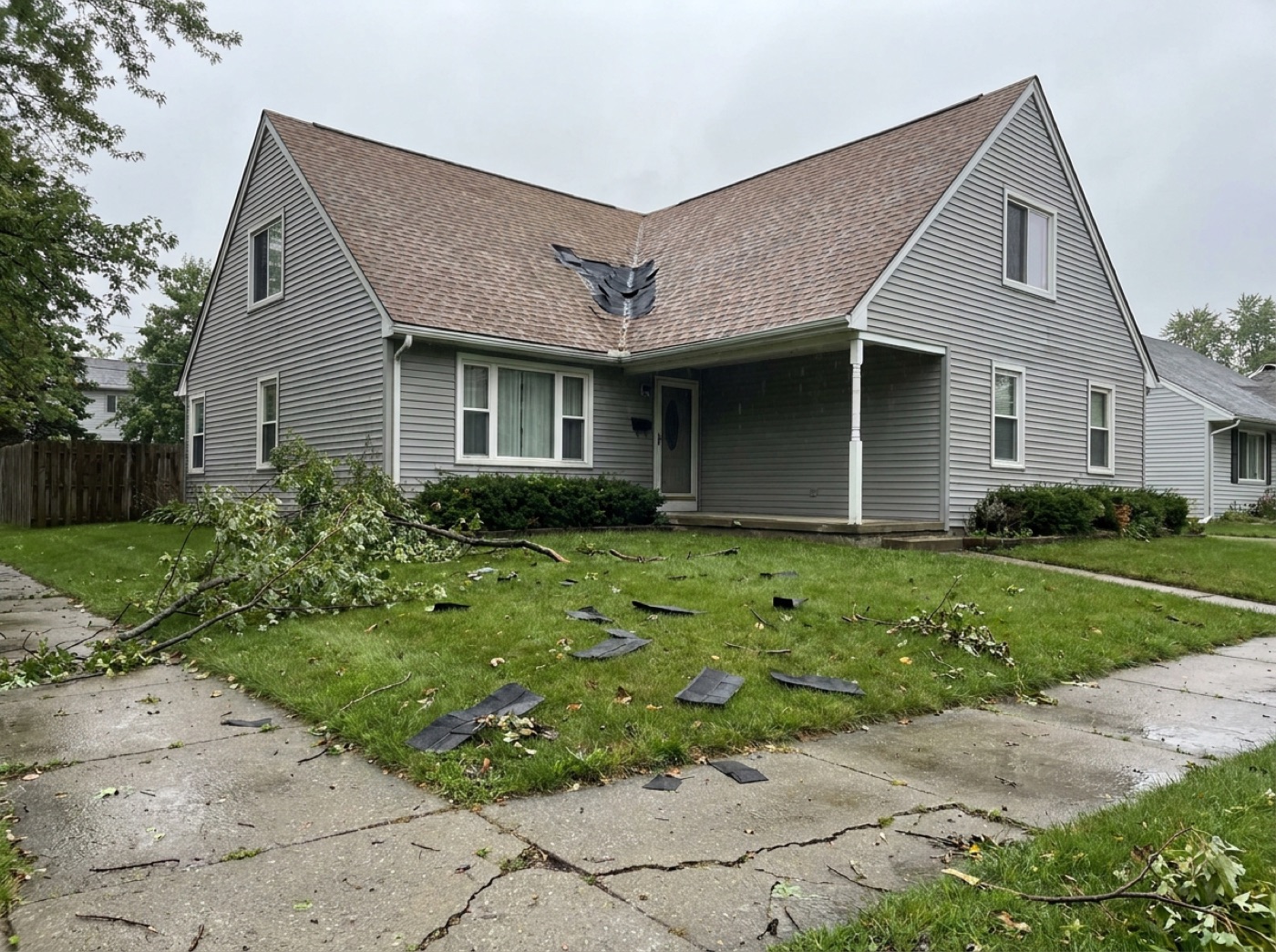
This is not an abstract engineering question here. After the severe wind event of August 2023, Macomb County was included in federal disaster declaration DR-4757, and the National Weather Service's own storm survey data for that event, cited in our sources, documents the kind of gusts the county actually saw. Roofs across the area took real, sourced-and-documented damage of exactly the kind this guide describes: broken seal bonds, creased and lifted shingles, and flashing that failed quietly and leaked weeks later, often on roofs that looked untouched from the street the morning after.
Southeast Michigan sits in a corridor that produces organized wind events, not just isolated gusts, multiple times most years, and a shingle roof here works against real, recurring wind loads over its service life, not a once-in-a-generation event. That is exactly why a shingle's printed rating matters less over time than its age and condition, and why a roof that went through the August 2023 event, or any notable wind event since, and was never inspected up close is carrying an open question that a ground-level glance cannot answer. Our guide on signs of wind damage on a roof walks the full component-by-component check, from field shingles to the damage that only shows up close, and our piece on roof wind uplift zones explains why that check should start at the corners rather than the middle of the roof.
One more honest point belongs in this section: a single documented storm event does not mean every roof in the county was damaged, and it does not mean an undamaged roof is now more vulnerable simply because it survived. What it does mean is that the wind speeds capable of hurting a roof have genuinely occurred here, on record, within the last few years, and will occur again. That fact turns this guide from general education into a practical local checklist. If your roof has not been looked at up close since a notable wind event, the open question is not whether wind speeds like that can damage a roof, that is documented, the open question is only whether yours took any.
05 / WHAT TO DOYou cannot measure your own roof's threshold, but we can check it
Nobody can hand you a single trustworthy wind speed number for your specific roof without knowing its age, its install history, and whether it already took quiet damage in a prior storm. What we can do is check those things directly. A free inspection covers the shingle field, the ridge, flashing and valleys, and the attic side of the deck, and tells you honestly whether your roof's real-world threshold, not its printed rating, still matches what the next storm is likely to bring.
In practice, that inspection is really answering the four questions raised in section 03 for your specific house: how old is the sealant strip, was the original install done to spec, is there any unrepaired damage from a past storm sitting on the roof right now, and does the lot's exposure suggest the next event will hit harder or softer than average. None of those four answers live in a manufacturer's spec sheet or a weather report, they live on your roof, which is exactly why a walk-through beats a guess every time.
If a recent wind event has already left decking or underlayment exposed, that is the one scenario here that should not wait for a scheduled visit; our 24/7 emergency tarping stops water intrusion while the permanent repair gets scheduled. Everything short of active exposure is exactly what a free inspection is for, whether that means confirming the roof is fine, scoping a repair, or documenting damage for a claim. We can meet your adjuster on site if a claim is the right path, though no contractor can promise how a carrier decides a claim. The full playbook from first photos to final invoice lives in our storm and insurance claims guide, and the honest ranges for whatever the roof needs are on our pricing page. And when the wind has already done its work, whether a policy answers for it is a separate question with a page of its own: is wind damage to a roof covered in Michigan.
- A shingle's printed wind rating is a lab number measured on a flat test panel, not a promise about your specific roof.
- Meaningful damage can start well below the speed of a named storm, since roofs fail on gusts, not the sustained speed in the forecast.
- Age, installation quality, prior unrepaired seal damage, and lot exposure move the real threshold more than the shingle class does.
- Damage concentrates at edges and corners, where actual wind load runs higher than a roof's average rated speed would suggest.
- Macomb County was included in FEMA disaster declaration DR-4757 after the August 2023 wind event, and events like it recur here.
Questions we hear most
There is no single number that applies to every roof. Meaningful damage, such as broken seal bonds or creased shingles, can begin at gust speeds well below the speed of a named storm on an older or poorly installed roof, while a newer, correctly installed, high-wind-rated roof can withstand considerably more. Age, installation quality, prior unrepaired storm damage, and how exposed your lot is all move the real number, which is why an inspection tells you more than any general figure can.
It tells you what that shingle can handle new, correctly installed, tested under controlled lab conditions on a flat panel. It does not account for your roof's age, how it was actually nailed, whether a prior storm already broke seal bonds nobody repaired, or how exposed your specific lot is. Real wind load also runs highest at roof edges and corners, well above the average speed the rating describes, so an aged or previously damaged roof can fail below its printed rating.
Yes. Macomb County was included in federal disaster declaration DR-4757 after the severe wind event of August 2023, and documented storm survey data shows the county saw gusts capable of the kind of shingle and flashing damage described in this guide. If your roof went through that event, or any notable wind event since, and was never inspected up close, a free inspection is the only reliable way to know whether it took quiet damage.
- FEMA, disaster declaration DR-4757-MI, Michigan severe storms of August 2023 (Macomb County designated). fema.gov/disaster/4757
- FEMA, disaster declaration DR-4757-MI, Michigan severe storms, tornadoes, and flooding of August 24 to 26, 2023 (Macomb County designated; declared February 8, 2024). fema.gov/disaster/4757
- ASTM D3161 and ASTM D7158, standard test methods and classifications for wind resistance of asphalt shingles.
- National Weather Service, Detroit/Pontiac forecast office: southeast Michigan forecasts, warnings, and event records. weather.gov/dtx