
JUMP TO A SECTION
Most homeowners think of storm damage as a single event: the wind blew, the hail fell, and afterward the roof is either fine or it is not. It is more useful, and more accurate, to think of a shingle as a small assembly of materials, each one built to resist a specific kind of stress, and to think of a storm as a force that finds whichever layer it is best suited to break. Wind attacks a different part of the shingle than hail does. Cold attacks a different part than heat does. Once you can see a shingle in layers instead of as one flat surface, the reason a guide on wind signs and a guide on hail signs describe such different damage stops being a mystery. This is the building-science piece underneath all of our storm identification guides, including signs of wind damage and signs of hail damage. Read it once and the rest read faster.
01 / THE SHORT ANSWEREvery storm force has a favorite layer
A standard architectural asphalt shingle is built from four functional layers: a fiberglass mat for structural strength, asphalt coating that waterproofs and binds the mat, mineral granules that shield the asphalt from the sun and add color, and a factory-applied sealant strip that bonds each course to the one below it. Wind mostly attacks the mat and the sealant strip, flexing the shingle until the mat fatigues and breaking the adhesive bond that keeps tabs down. Hail mostly attacks the granules and the asphalt underneath them, cratering the surface and knocking the mat's protective coating loose. Heat, cold, and the freeze-thaw cycle in between act more slowly, but they work on every layer at once, and they are especially good at finishing off damage that wind or hail started but did not complete.
Fiberglass mat (structure) fatigues under wind flutter. Asphalt and granules (weatherproofing) fracture and displace under hail impact. Sealant strip (the bond between courses) breaks under wind uplift and degrades under UV and heat. Freeze-thaw cycling works every layer at once, and does its worst work on damage that already exists.
02 / THE ANATOMYWhat is actually inside an asphalt shingle
Pick up a cutaway of a modern architectural shingle and you can see the whole assembly in cross section. At the core is a fiberglass mat, a thin, woven fiberglass sheet that gives the shingle its tensile strength and its fire rating. Without the mat, asphalt alone would crack and sag; the mat is what lets a shingle flex in the wind and snap back instead of tearing.
Saturating and coating that mat on both sides is the asphalt itself, a petroleum-based compound that does the actual waterproofing. The asphalt on the weather-facing side carries the mineral granules, and the asphalt on the underside is what bonds to the sealant strip of the course below. Asphalt is stiff in cold weather and softer in heat, which matters more than it sounds, because a shingle's resistance to cracking under impact changes with the outdoor temperature.
On top of the weather-facing asphalt sit the mineral granules, the small ceramic-coated stone particles that give a shingle its color and, more importantly, block ultraviolet light from degrading the asphalt underneath. Granules are embedded into the hot asphalt during manufacturing, but they are never permanently locked in place; some shedding is normal over a shingle's life, and a storm can knock loose far more than normal wear ever would.
Finally, a factory-applied sealant strip runs along the shingle, a strip of asphalt-based adhesive that activates in sunlight and bonds each course to the top edge of the course below it. That bond is what keeps the whole field of shingles acting as one continuous surface instead of a stack of loose overlapping pieces, and it is one of the first things a real storm compromises, often without leaving any visible sign that it happened.
03 / WINDWhat wind attacks: the mat and the seal
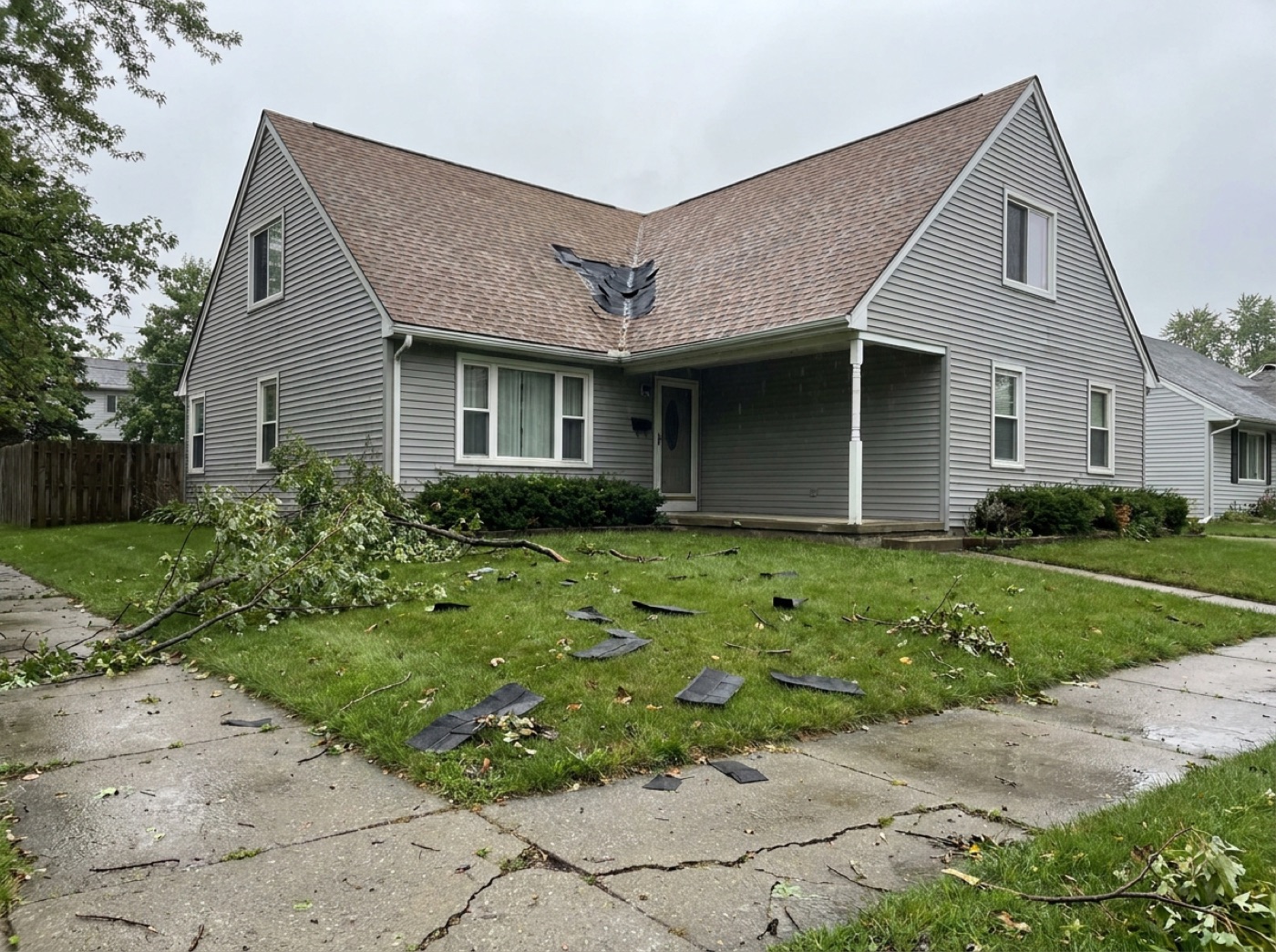
Wind does not usually hit a shingle once. It flutters it, lifting the free edge of a tab and letting it snap back, over and over, for as long as the gust holds. That repeated flexing is a fatigue load on the fiberglass mat, the same mechanism that eventually snaps a piece of sheet metal bent back and forth by hand. A single strong gust can fracture the mat along a line, which shows up as a faint crease, a shadow that runs across the tab and is often invisible unless the light hits it at a low angle. A creased shingle has not lost any material and looks intact from the ground, but the mat underneath is already broken, and it will not repair itself or improve with time.
The same flutter that creases the mat also works directly on the sealant strip. Every course is designed to bond to the one above it, and that bond is what resists wind trying to get a tab's edge up and underneath it. Enough uplift force snaps the bond even if the shingle itself is undamaged, and once broken, the adhesive rarely reseals reliably, because dust and grit contaminate the exposed strip the moment it separates. A shingle with a broken seal will lift more easily in the next ordinary breeze than it did before the storm, which is exactly why one wind event tends to make a roof more vulnerable to the next one rather than resetting it.
Past a certain wind speed, flutter stops creasing and starts tearing. A tab can rip along the crease line it developed in an earlier event, or a shingle with an already-broken seal can peel back and blow off entirely, exposing the underlayment or bare decking beneath it. That progression, crease, then broken seal, then tear, is why the same wind speed can leave one roof with a few faint creases and another roof, with older or already-weakened shingles, missing several tabs outright.
04 / HAILWhat hail attacks: granules and the asphalt beneath
Hail works on a completely different part of the shingle. Where wind is a flex load applied at the edge of a tab, hail is a direct impact load applied to the face of it, and the first layer in its path is the mineral granule surface. A hailstone striking a shingle displaces the granules at the point of impact, sometimes knocking them loose entirely and sometimes just driving them down into the asphalt beneath, and either way the impact point ends up with less UV protection than the surrounding shingle.
Underneath the disturbed granules, the impact can crack or fracture the asphalt layer itself and, at higher energy, fracture the fiberglass mat below that. A soft bruise, where the granules are displaced but the mat is intact, is a cosmetic mark that does not threaten the shingle's ability to shed water. A fracture that reaches the mat is a functional break, a wound that the asphalt can no longer seal on its own, and it behaves like a hole waiting for enough freeze-thaw cycling or sun exposure to open it up. Our companion guide on functional versus cosmetic hail damage goes deeper on telling the two apart, because they look similar from a distance and are priced and treated very differently.
Hail size, shingle age, and outdoor temperature at the moment of impact all change how deep that damage goes. A shingle that is cold and stiff, as most are during a spring hailstorm in Michigan, is more brittle and more likely to fracture at the mat than the same shingle would be on a warm summer afternoon, when the asphalt has softened enough to absorb some of the impact instead of cracking under it. Older shingles, whose asphalt has already lost some flexibility to age and UV exposure, are also more prone to a full-depth fracture from a hailstone that a newer roof would only bruise.
05 / HEAT, COLD, AND THE THAWWhat temperature swings attack: everything, slowly
Wind and hail are events. Heat, cold, and the freeze-thaw cycle between them are a condition, working on the shingle continuously rather than in a single storm, and Michigan's climate puts a roof through more of that condition than almost any other force it faces. Asphalt is a thermoplastic material, meaning it stiffens in the cold and softens in the heat, and every seasonal swing flexes the shingle slightly as it expands and contracts. Over enough cycles, that flexing works the same fatigue mechanism as wind flutter, just far more slowly and far more evenly across the whole roof.
The freeze-thaw cycle adds a second mechanism on top of the first. Any place water has already found its way past the granule surface, whether through a hail fracture, a wind crease, or a broken seal, can carry a small amount of moisture into the wound. When that moisture freezes, it expands, and the expansion widens whatever crack or gap let it in to begin with. The ice melts on the next warm day, the water recedes, and the cycle repeats on the next freeze, each pass a little worse than the last. This is why a roof that took a hailstorm in May can show a leak that was not there in June but shows up clearly by the following March: the freeze-thaw season did the work that the hailstorm only started.
UV exposure works on a similar slow timeline, degrading the asphalt's oils and flexibility over years of sun regardless of any single storm. That is precisely why the granule layer matters as much as it does: granules are the roof's sunscreen, and any area where they have been displaced by hail or scrubbed loose by wind flutter ages faster than the shingle around it, because the asphalt there is taking direct UV exposure it was never designed to absorb long term.
06 / WHY WOUNDS COMPOUNDWhy old damage makes new damage worse
None of these mechanisms work in isolation on a real roof that has stood through more than one Michigan storm season. A shingle creased by a spring wind event is more brittle at that crease line by the time a summer hailstorm arrives, and a hailstone landing on an existing crease is more likely to fracture straight through than the same hailstone landing on undamaged material nearby. A sealant strip weakened by one wind event bonds even less reliably the next time wind tries to lift it, because the contamination and micro-tears from the first failure do not heal. Every unaddressed wound becomes the weak point the next storm finds first.
This compounding is the real argument for inspecting a roof after any notable event rather than waiting until a leak shows up inside the house. A leak is usually the last stage of a process that started one or two storms earlier, once wind, hail, and freeze-thaw had each taken their turn on the same weakened area. Our guide on storm damage that gets worse over time walks through that timeline in more detail, and it is the reason a free inspection after a storm is worth doing even when nothing looks wrong from the driveway.
It also explains why two roofs that took the same storm can age at very different rates afterward. A newer roof with intact granule coverage and flexible asphalt absorbs an ordinary wind or hail event with only minor, mostly cosmetic marks, because every layer still has some reserve capacity to flex and reseal. An older roof that already lost granules to a prior storm, or already carries a handful of unrepaired creases from a windy spring, has less reserve left in the mat and the seal strip, so the same storm pushes it measurably closer to failure. Roof age and storm history are not separate questions; they are the same question asked from two different directions, which is why an inspector always asks how old the roof is and what it has been through before forming an opinion about a new mark.
A shingle rarely fails from one storm. It fails from the second or third storm landing on damage the first one already caused.
07 / YOUR ROOFReading your own roof against this anatomy
Once you know which layer each force attacks, your own roof's history starts to read differently. A roof that has taken mostly wind events will tend to show creased tabs and lifted courses concentrated at the eaves and corners, where wind uplift is strongest, which our guide to signs of wind damage maps component by component. A roof that has taken a direct hail hit will tend to show granule displacement and bruising scattered across every slope facing the storm, which our guide to signs of hail damage covers in the same detail. A roof nearing the end of its rated life, regardless of any single storm, will show the slow fatigue of years of freeze-thaw and UV exposure: brittle tabs, widespread granule loss, and a mat that cracks under a gentle lift rather than flexing back.
None of that is something a homeowner needs to diagnose alone. What the anatomy above is meant to give you is the vocabulary to understand what an inspector is actually looking for and why a photo of a small bruise or a faint crease is being treated as a real finding rather than a nitpick. A trained eye is checking the mat, the seal, and the granule layer specifically, because those are the three places every storm force in Michigan leaves its mark, whether or not that mark is visible from the ground.
If you want an inspection built around exactly this framework, ours is $0 with no obligation, and it covers the field shingles, the ridge, flashing, vents, and the attic side of the deck, with photos of anything we find at any of the four layers described above. If the roof checks out sound, we tell you that plainly. If a repair is warranted, Macomb County repairs typically run $350 to $3,200 depending on scope, and you get a written price before any work starts. You can review the same figures on our honest pricing page, model your own roof on the cost calculator, or start a storm-specific estimate directly from the estimator.
- A shingle is four layers: fiberglass mat, asphalt coating, mineral granules, and sealant strip, and each storm force attacks a different one.
- Wind mostly fatigues the mat and breaks the sealant bond; hail mostly displaces granules and fractures the asphalt and mat beneath.
- Freeze-thaw and UV exposure work all four layers continuously and do their worst damage inside wounds that wind or hail already opened.
- Damage compounds across storm seasons, which is why a leak often traces back to an earlier event that was never inspected.
- A free inspection checks the mat, seal, and granule layer directly; repairs typically run $350 to $3,200 with a written price first.
Questions we hear most
Wind flutters the shingle's free edge repeatedly, fatiguing the fiberglass mat until it creases or cracks, and it also strains the factory sealant strip that bonds each course to the one below until that bond breaks. A creased or unsealed shingle can look intact from the ground but is functionally more vulnerable to the next wind event.
Hail is a direct impact load on the face of the shingle rather than a flex load on its edge, so it mainly displaces mineral granules and can fracture the asphalt and fiberglass mat beneath the impact point. Wind mostly attacks the mat through flutter and the sealant strip through uplift, which is why wind and hail damage tend to look and cluster differently on the same roof.
Wind and hail can crease or fracture a shingle without opening a visible leak right away, and the freeze-thaw cycle then works inside that existing wound each winter, widening it a little more with every freeze and thaw. Unaddressed damage from an earlier storm is usually what turns a smaller event later into an actual interior leak, which is why a free inspection after any notable storm is worth doing before symptoms show up inside the house.
- FEMA, disaster declaration DR-4757-MI, Michigan severe storms of August 2023 (Macomb County designated). fema.gov/disaster/4757
- Manufacturer technical and warranty literature for the major asphalt shingle lines: GAF (gaf.com), Owens Corning (owenscorning.com), and CertainTeed (certainteed.com).
- National Roofing Contractors Association, technical guidance for steep-slope roof systems. nrca.net