
EPDM vs Modified Bitumen for Michigan Flat Roofs
Two proven flat roof systems, one flat and commercial canon. Here is the honest side by side so you spend the same $9,000 to $16,000 on the system that actually fits your deck.
Both systems live inside the same $9,000 to $16,000 flat and commercial canon, so the honest question is fit, not price. A simpler deck with light traffic, where an owner values a proven single-ply membrane and easy patch repairs, usually favors EPDM. A roof carrying more foot traffic, more equipment, or an owner who wants the built-in redundancy of multiple plies usually favors modified bitumen, provided a qualified crew is available for the application method chosen. A free inspection puts real numbers on your deck, traffic pattern, and drainage before you pick either one.
Ask about a flat roof replacement in Macomb County long enough and modified bitumen comes up alongside EPDM and TPO as the third proven option, older than either single-ply membrane and still common on roofs with real rooftop traffic. Both EPDM and modified bitumen live inside the same $9,000 to $16,000 flat and commercial canon, and both will keep a low-slope roof dry for decades when installed correctly. The real comparison is not which system is objectively superior. It is which system suits your deck: how much foot traffic and equipment it carries, what installer skill is actually available to you, and whether you value a flexible single-ply rubber sheet or the layered redundancy of a multi-ply asphalt system. That is the ledger this page runs, line by line.
01 /What each system actually is
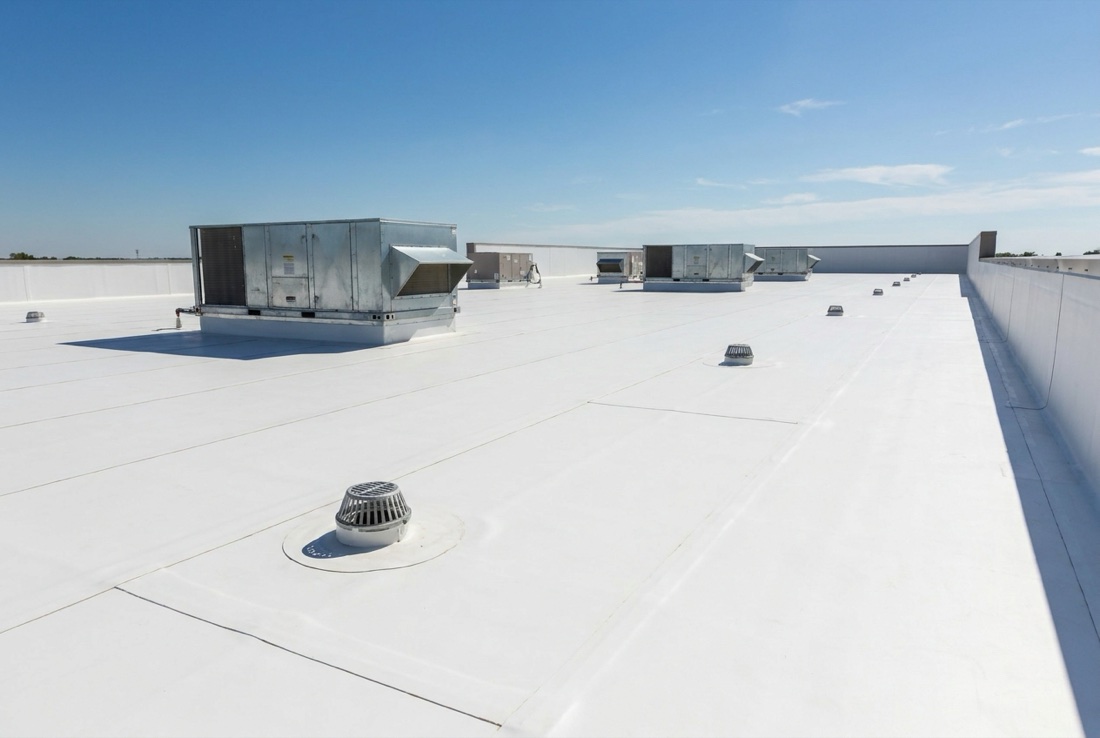
EPDM is a synthetic rubber, ethylene propylene diene terpolymer, that has been used on American commercial roofs since the 1960s. It ships as large single-ply sheets, traditionally black, though white EPDM exists at a premium for owners who want a reflective surface. Seams are joined with liquid adhesive or, on newer installs, factory-applied seam tape, bonding two sheet edges together into one continuous plane. EPDM can be fully adhered, mechanically fastened, or ballasted under stone, and it is prized for flexibility: the membrane stretches and recovers as the deck below expands and contracts through Michigan's temperature swings.
Modified bitumen is a different animal entirely: an asphalt-based sheet reinforced with polyester or fiberglass mats and modified with rubber or plastic polymers for added flexibility over old-style built-up roofing. It is typically installed in two or more plies, a base sheet plus a cap sheet, giving the finished roof redundant layers rather than a single membrane. The cap sheet usually carries mineral granules, which makes the finished surface walkable and gives it a texture closer to a traditional roof than a smooth rubber sheet.
Both systems sit on a similar assembly underneath: rigid insulation board, often tapered to build in slope toward drains, over a structural deck. That underlying system, the insulation, the slope, and the drainage design, decides how a flat roof survives Michigan winters as much as which membrane sits on top. You can see how we handle that assembly on our commercial and flat roofing page.
02 /Upfront cost: the real numbers
Here is the honest starting point: in Macomb County, flat and commercial roofing, EPDM, modified bitumen, or TPO, runs $9,000 to $16,000 installed. Choosing modified bitumen over EPDM on the same roof rarely moves the price by a meaningful amount on its own. What moves the number inside that range is square footage, deck condition, how many plies and courses of modified bitumen the job specifies, whether tapered insulation is needed to fix a drainage problem, and how much of the old roof has to be torn off versus recovered.
EPDM and modified bitumen both fall inside the $9,000 to $16,000 flat and commercial range. The membrane family rarely swings your quote by itself; ply count, insulation, drainage design, and the number of roof penetrations do most of that work. See the full breakdown on our pricing sheet.
For context, here is the full canon of what roofs cost across every system we install in Macomb County:
| System | Typical Installed Range |
|---|---|
| Asphalt shingle replacement (most homes $12,000 to $16,000) | $9,000 to $18,000 |
| Metal replacement (standing seam, stone-coated steel) | $18,000 to $30,000 |
| Tile and slate replacement | $20,000 to $36,000 |
| Flat and commercial (TPO, EPDM, modified bitumen) | $9,000 to $16,000 |
| Roof repairs (larger or complex repairs can run higher) | $350 to $3,200 |
Run the back of the envelope math using the midpoint of the flat and commercial canon and typical service life, and the picture looks like this. This is an illustration, not a quote, and it only holds if the roof is maintained and the drainage was designed correctly:
03 /Application methods and how each system actually fails
A flat roof rarely fails in the open field of the membrane. It fails at a seam, a flashing, or a penetration, and how each system creates those seams is worth understanding before you pick a side. EPDM seams rely on adhesive bonding or factory seam tape rather than a weld. Older cold-applied liquid adhesive seams were the most common failure point on EPDM roofs for decades, since the bond degrades with age and UV exposure and a compromised seam does not always show itself until you are chasing a leak inside the building. Modern tape systems have closed most of that gap and are considerably more consistent than the old glue and roller method, but the seam is still a bonded lap rather than a fused piece.
Modified bitumen application varies by product and installer preference: torch-applied, where the crew melts the underside of the sheet with an open flame to bond it to the substrate; hot-mopped, using kettle-heated asphalt; or self-adhered, using a factory-applied adhesive backing that skips open flame entirely. Torch application demands real fire safety discipline on the roof and a crew experienced with the method, since a rushed torch pass is a documented cause of roof fires during installation. Self-adhered modified bitumen has become the more common choice on occupied buildings for exactly that reason.
The redundancy built into modified bitumen is its structural advantage: a base ply and a cap ply means a single compromised lap in the top layer does not automatically mean a leak, the way a single failed EPDM seam can. That redundancy comes at the cost of more seams overall, since each ply has its own set of laps to detail correctly. We cover exactly how each system's seams age in our flat roof seam failure guide, and if you want the fundamentals on either material by itself, our EPDM roofing guide and modified bitumen roofing guide both go deeper than we have room for here.
04 /Ponding water, freeze-thaw, and Michigan winters
Every flat roof in Michigan holds some water after a storm; the question is how long it sits and what it does while it is there. EPDM tolerates short-term ponding reasonably well since the rubber does not degrade quickly from standing water alone, though prolonged ponding still stresses seams and adds dead weight in a hard freeze. Modified bitumen's granulated surface sheds UV well but its multiple plies can be more sensitive to ponding over many years, since trapped moisture between layers is harder to spot from the surface. Tapered insulation that routes water to drains within about 48 hours is the actual fix for ponding on either system, and it matters more than which membrane sits on top.
Freeze-thaw cycling works on the details more than the field: parapet flashings, curb flashings around rooftop units, and drain bowls all move slightly as temperatures swing, and that movement is where leaks start on both systems. Read more about how drainage design decides the outcome in our flat roof drainage guide and ponding water guide.
Wind is the other Michigan factor on a flat roof. Macomb County was part of federal disaster DR-4757 after the August 2023 wind event, and uplift at roof edges and corners, where wind pressure is highest, is one of the most common things we find during storm inspections on flat roofs of either type. Both EPDM and modified bitumen need correct fastening patterns and edge metal rated for the wind zone; neither system is inherently more wind resistant than the other when installed to spec. Our commercial flat roof insurance claims guide covers how that documentation works after a storm.
05 /Rooftop traffic, equipment, and puncture resistance
If your roof carries HVAC units, a satellite array, or maintenance staff walking it regularly, this is the section that should decide the comparison. Modified bitumen's granulated cap sheet is inherently more walkable and more resistant to point punctures from dropped tools or foot traffic than a smooth membrane, which is part of why it remains common on roofs with routine service access. EPDM handles occasional foot traffic fine but scuffs and can be punctured by a sharp object more easily than a granulated multi-ply surface, and walkway pads at ladders, doors, and equipment service paths are worth specifying on any EPDM roof with regular traffic.
Both membranes are also sold in multiple thicknesses, and thickness matters as much as the material family for puncture resistance within either category. Neither system's traffic advantage is large enough to override the seam application and installer availability factors above on its own, but on a roof that sees weekly service visits, modified bitumen's inherent walkability is a real point in its favor.
06 /Lifespan, maintenance, and everyday repairs
Both systems are repairable, and the same rule applies to either one: a small membrane problem caught early is a $350 to $3,200 repair, with larger or complex repairs running higher, and a small problem ignored for a few winters can turn into a full roof replacement conversation. EPDM patches use liquid adhesive or tape systems with careful surface preparation, and the patch is only as reliable as that prep work. Modified bitumen patches typically involve a matching cap sheet piece heat-welded, torched, or self-adhered over the damaged area, which an experienced mod-bit crew can usually blend well into the existing granulated surface.
EPDM is commonly rated for 25 years or more of service with regular maintenance, and modified bitumen typically delivers 20 to 30 years depending on ply count and installation quality. In practice, installation quality, seam integrity, and how well drainage is designed matter more to actual lifespan than the material family. An annual inspection that catches a lifted EPDM seam or a blistering mod-bit lap early does more for either roof's lifespan than the brand on the roll, and our flat roof lifespan guide covers how both systems compare to TPO over a full service life.
07 /Financing the gap
Most building owners finance a flat roof replacement rather than paying cash, and financing puts the choice between systems in perspective. Spread across a term, the difference between an EPDM payment and a modified bitumen payment on a comparable roof is usually a small monthly number, not a meaningful budget decision on its own.
A $13,500 roof financed on a 10 year term at 9.9% APR runs about $178 per month. Subject to approval; illustration only, and your rate, term, and project size will differ. Run your own numbers on the cost calculator before you decide.
Financing is available on both systems, subject to approval, and we will put payment options for EPDM and modified bitumen side by side in a written quote so the comparison stays honest, not just the sticker price.
08 /How to decide
Strip away the product literature and the decision usually comes down to four honest questions. How much foot traffic and rooftop equipment will this membrane actually carry over its life? Is a crew experienced in the specific application method, torch, hot-mop, self-adhered, or EPDM tape, genuinely available for your project, since a rushed unfamiliar install is the real risk on either system? Do you want a single flexible rubber sheet with the longest single-ply track record, or the layered redundancy of a multi-ply asphalt system? And what does your actual roof, its drainage, its penetrations, its deck condition, look like once someone puts eyes on it?
- EPDM and modified bitumen both fall inside the same $9,000 to $16,000 flat and commercial canon.
- EPDM's single-ply rubber suits simpler, lower-traffic roofs with a proven long-term track record.
- Modified bitumen's multi-ply redundancy and walkable surface suit roofs with real foot traffic.
- Repairs run $350 to $3,200 either way; larger or complex repairs run higher.
- Installer experience with the specific application method matters as much as the membrane itself.
If you want the three-way comparison including TPO, our TPO vs EPDM vs modified bitumen guide lays all three side by side, and our TPO vs EPDM comparison is worth a look if reflectivity and sun exposure matter more to your roof than traffic and redundancy. Or skip the reading: price both systems for your roof in under a minute, or call for a free inspection and we will hand you honest numbers for both.
09 /Questions we hear on estimates
Questions we hear most
Neither one moves the price by itself. Flat and commercial roofing, EPDM, modified bitumen, or TPO, runs $9,000 to $16,000 installed in Macomb County. What changes the number more than the membrane family is square footage, deck condition, ply count, and how much tapered insulation or drainage work your roof needs. A free inspection gives you a real number for your building on either system.
Both can deliver decades of service with regular maintenance. EPDM is commonly rated for 25 years or more, while modified bitumen typically delivers 20 to 30 years depending on ply count and installation quality. In practice, installation quality, seam integrity, and drainage design matter more to actual lifespan than the material family.
Modified bitumen's granulated cap sheet is generally more walkable and more resistant to point punctures than a smooth EPDM membrane, which is part of why it remains common on roofs with routine equipment service. EPDM handles occasional foot traffic fine, but walkway pads at ladders, doors, and service paths are worth specifying if your roof sees regular visits.